Are solar panels worth it on the Costa del Sol?
For most occupied homes, yes. The coast gets strong sun all year, and every kWh you use straight from your panels is one you do not buy from the grid. The best results come where the roof has unshaded space and the property uses a good share of its electricity in daylight: pool pumps, air conditioning, hot water, home working.
A system sized from your consumption
Filling every square metre of roof is rarely the right answer. A system that is too big exports a lot of cheap surplus to the grid; one that is too small leaves daytime loads on grid power. We size the array from twelve months of bills, the hours the property is occupied and the equipment you plan to add, such as an electric car or a pool heat pump.
For a typical permanently occupied villa that usually means somewhere between 3 and 8 kWp. Apartments and townhouses are often smaller, and large villas with pools and several air-conditioning zones can be bigger. You can get a first idea with our system size estimator.
What the installation includes
- Site survey of the roof, shade, fixing points, cable route and fuse board
- Panel layout across the best roof planes, flat roof or carport
- Inverter or Enphase microinverters, mounting, DC and AC protection and isolators
- Monitoring set up on your phone, so you can see production and consumption
- Electrical certificate, registration in Andalucía and the paperwork for surplus compensation
- Manufacturer warranties registered in your name
Roofs we work on
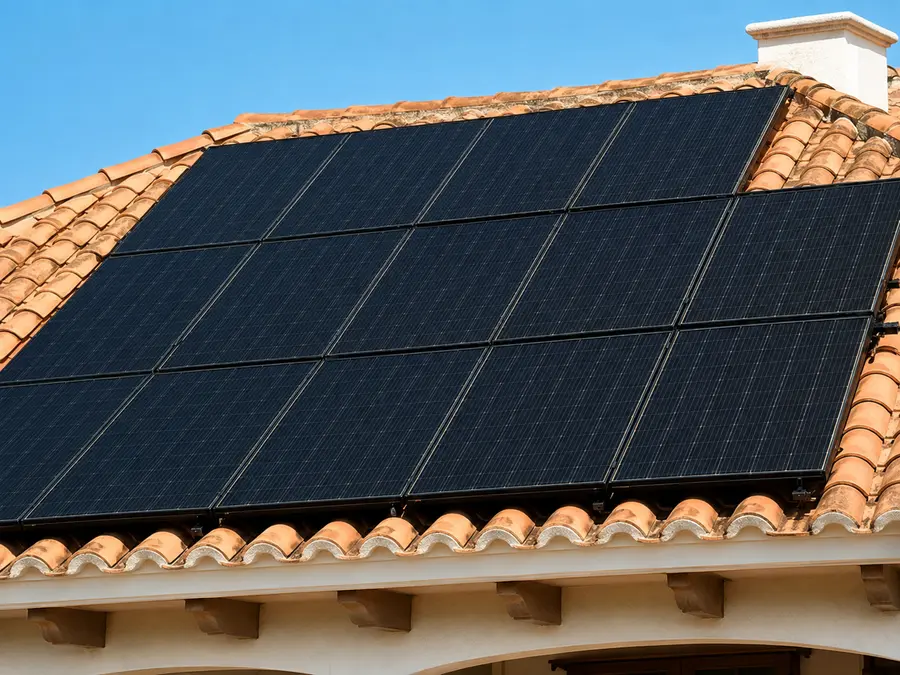
Tiled pitched roofs, flat roofs with ballasted or fixed frames, roof terraces where the layout keeps the terrace usable, carports and pergolas. Split-level villas are common on the coast; where a roof faces several directions or has patches of shade we look at microinverters or optimisers so each panel works on its own.
East and west roofs are worth using here. They spread generation across the morning and late afternoon, when many households use more power than at midday.
Using more of your own solar
The quickest gains come from moving loads into the middle of the day: pool filtration, hot water, the dishwasher and washing machine, and charging an electric car. We set timers and smart controls where they help, and monitoring shows you what is working. A battery then takes the genuine surplus into the evening, if your pattern of use supports one.
Adding to an existing system
We extend older systems, replace failed inverters and add batteries to installations other companies fitted. We check that the existing panels, inverter and wiring are compatible first. See inverter replacement and upgrades.
Questions we are often asked
How many solar panels do I need?
There is no reliable number from the size of the house. It depends on annual consumption, how much you use in daylight, the roof area, orientation, shade and what you plan to add. Many occupied homes on the coast end up with 8 to 16 panels.
Do solar panels work in winter here?
Yes. Output is lower on short days and cloudy spells, but panels on the Costa del Sol keep producing all year, and winter sun here is far stronger than in northern Europe.
Which direction should the panels face?
South is usually the most productive, but east and west roofs work well and spread generation through the day. Pitch, shade and when you use electricity matter as much as direction.
Can I add a battery later?
Usually. If you think you will want one, we fit a hybrid inverter or battery-ready system from the start so adding storage later is straightforward.
Can solar panels run my air conditioning?
They can cover a large share of daytime cooling, because the hottest hours are also the sunniest. How much depends on the size of the array and what else is running.
How long does the installation take?
Most homes are installed in one to three days once the design is agreed and the equipment is on site. Registration follows after the installation.